
IP Addressing 3
Topology
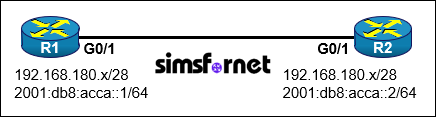
Tasks:
Configure IPv4 and IPv6 connectivity between two routers. For IPv4, use a /28 network from the 192.168.180.0/24 private range. For IPv6, use the first /64 subnet from the 2001:0db8:acca::/48 subnet.
- Using GigabitEthernet0/1 on routers R1 and R2, configure the next usable /28 from the 192.168.180.0/24 range. The network 192.168.180.0/28 is unavailable.
- For the IPv4 /28 subnet, router R1 must be configured with the first usable host address.
- For the IPv4 /28 subnet, router R2 must be configured with the last usable host address.
- For the IPv6 /64 subnet, configure the routers with the IP addressing provided from the topology.
- A ping must work between the routers on the IPv4 and IPv6 address ranges
Solution:
Task 1-3: Assign IPv4 addresses on R1 and R2 for the 192.168.180.16/28 subnet
The network 192.168.180.0/24 covers all addresses from 192.168.180.0 to 192.168.180.255, total: 256 addresses.
A /28 subnet = 16 IP addresses (24 = 16), which breaks the /24 into 16 blocks. Each /28 block starts every 16 IPs:
- 192.168.180.0/28 ranges from .0 to .15
- 192.168.180.16/28 ranges from .16 to .31
- 192.168.180.32/28 ranges from .32 t0 .47
- ... and so on
The first block 192.168.180.0/28 overlaps with the existing network address of 192.168.180.0/24, so we skip it and use the next /28, which is 192.168.180.16/28.
- Network address: 192.168.180.16 (reserved, not usable).
- Broadcast address: 192.168.180.31 (also reserved).
- Usable host range: 192.168.180.17 to 192.168.180.30.
- Total: 14 usable IPs.
We will assign .17 (first usable address) to R1's G0/1 and .30 (last usable address) to R2's G0/1. /28 prefix length = 255.255.255.240 subnet mask.
On R1:
R1# configure terminal
R1(config)# interface g0/1
R1(config-if)# ip address 192.168.180.17 255.255.255.240
R1(config-if)# no shutdown
R1(config-if)# exit
On R2:
R2# configure terminal
R2(config)# interface g0/1
R2(config-if)# ip address 192.168.180.30 255.255.255.240
R2(config-if)# no shutdown
ip address 192.168.180.30 255.255.255.240: Sets g0/1 to the last usable address. /28 prefix length is equal to 255.255.255.240.
Verification:
R1# ping 192.168.180.30
Type escape sequence to abort.
Sending 5, 100-byte ICMP Echos to 192.168.180.30, timeout is 2 seconds:
!!!!!
Success rate is 100 percent (5/5), round-trip min/avg/max = 2/2/2 ms
Task 2:
- Do not assign the subnet router anycast address to either router.
- Configure R1 with the first usable host IP address in the IPv6 network.
- Configure R2 with the last usable host IP address in the IPv6 network.
- Verify connectivity using ping
For /125 network 2001:db8:12::60, the first address (2001:db8:12::60) is reserved for the subnet router anycast (similar to the "network address" in IPv4).
As IPv6 is 128 bit, /125 prefix length reserves 125 bits which means that only 3 bits are remaining for host addresses. 23 -1(anycast) = 7, the remaining usable addresses range from 61 to 67.
R1 gets: 2001:db8:12::61/125 (first usable address)
R2 gets: 2001:db8:12::67/125 (last usable address)
On R1:
R1# configure terminal
R1(config)# interface g0/1
R1(config-if)# ipv6 address 2001:db8:12::61/125
R1(config-if)# exit
ipv6 address 2001:db8:12::61/125: Sets g0/1 to the first usable address.
On R2:
R2(config-if)# ipv6 address 2001:db8:12::67/125
R2(config-if)# exit
ipv6 address 2001:db8:12::67/125: Sets g0/1 to the last usable address.
Verification:
R1# ping 2001:db8:12::67
Type escape sequence to abort.
Sending 5, 100-byte ICMP Echos to 2001:db8:12::67, timeout is 2 seconds:
.!!!!
Success rate is 100 percent (5/5), round-trip min/avg/max = 4/4/4 ms
Save all configurations to NVRAM:
R1# write
R2# write
Packet Tracer File
Clicking this button will begin the download of a ZIP file. Inside the ZIP file, you'll find a Packet Tracer Activity (.pka) file, which will automatically track your progress as you configure the network.